Chess Classes for Kids in Surat
Structured, offline chess coaching for children at Surat Chess Club in Vesu — small batches on real boards, a coach who is in the room for every session, and a ten-level curriculum that takes a child from "the horse moves funny" to their first tournament. Children start with us from age four, and there is no upper age limit. Every child starts with a free trial class.


What chess does for a child that a screen cannot
Parents in Surat come to us for many reasons — a child who cannot sit still, a child who is bright but bored, a child who plays on an app and wants "real" chess. What they see after a term is the same: a child who thinks before acting. (More on this, and on what the research says, in our guide to the benefits of chess for kids.)
Attention that lasts
A game of chess is twenty to forty minutes of sustained focus on one problem. Nothing else a seven-year-old does voluntarily asks that of them.
Thinking before moving
"If I go here, what does he do?" is the first question we teach. It transfers — to maths, to reading a question properly, to not blurting an answer.
Losing well, winning quietly
Every child loses games here, including the strongest. They learn to shake hands, look at why, and play again. Parents tell us this is the part they did not expect.
A room of peers, not a screen
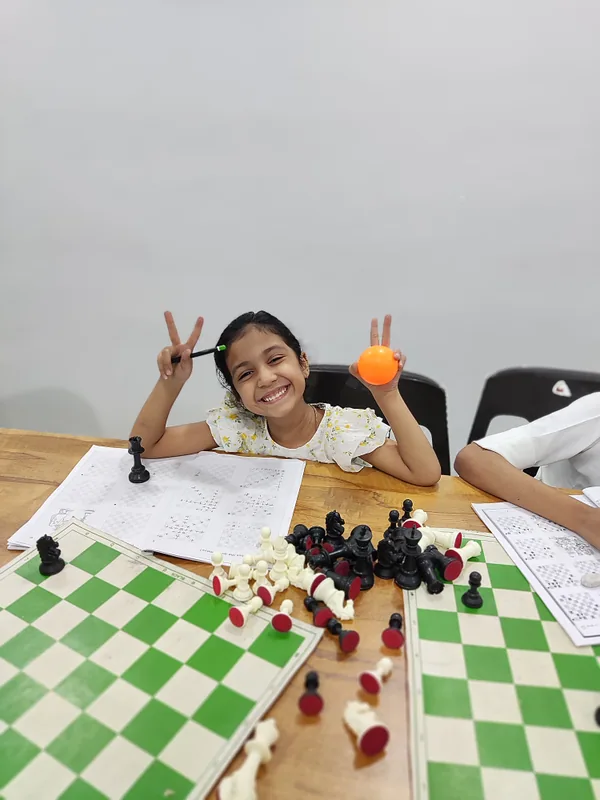
Children play a batchmate across a real board, with a coach beside the table. Apps are useful for practice later; they are not where a child learns the game.
Where a child starts, age by age
We place by what a child already knows and how long they can sit with a puzzle — not by birthday. These are the usual starting points.
The youngest beginners
Piece names and moves as stories, mini-games on a half board, and lots of getting up and down. Sessions stay short and active. Every beginner starts at Foundation 1, on whichever plan suits the family; a four-year-old is usually ready for a first tournament after about a year, a six-year-old after about six months.
The sweet spot
Old enough to hold a plan for a whole game, young enough that habits form fast. Full games from week three or four, first checkmate patterns, first after-class assignments. An eight-year-old beginner is often ready for a first tournament within three months.
Serious about it
Tactics, openings and endgames in a deliberate order, three times a week on the Rook Plan or every day on the Queen Plan, then rated tournaments in Surat and Gujarat. Ambitious teenagers move on to FM Jeet Jain.
Inside a children's class
Sixty minutes, three parts. The coach opens with one idea on the demonstration board — never two. The children then try that idea on their own boards from puzzle sheets while the coach moves between the tables; this is where the one-to-one feedback happens. The last twenty minutes are a real game against a batchmate, using the idea of the day.
Batches are grouped by level, so a seven-year-old beginner is not sitting with a twelve-year-old tournament player. Every student — from the first term — plays with a clock and records moves, so nothing in a tournament hall is new to them. Parents get a short progress note every month, and can always ask the coach at pick-up.
- Physical tournament boards and weighted pieces — no screens in class
- Batches capped so every child gets direct feedback each session
- Workbooks and puzzle sheets included in the fees
- Classes in English, Hindi or Gujarati — whichever the child thinks in
- Chess clocks and move notation from the first term, on every plan
- Monthly progress note to parents

The practical things parents ask first
Tuesday to Friday 4:00–8:00 PM, Saturday 10:00 AM–1:00 PM and 4:00–8:00 PM, Sunday 10:00 AM–1:00 PM and 2:00–4:00 PM. School-day batches run after school; weekend batches suit families further out in Surat.
Knight Plan ₹4,999 for three months (2 classes a week), Rook ₹6,999 (3 a week), Queen ₹10,999 (every day, Tuesday to Saturday). Knight, Rook and Queen are the same class with the same coach. You only choose how often. Workbooks included, and the first trial class is free. All plans and fees.
First floor, Canal Walkk Shoppers, VIP Road, Vesu — directly opposite L.P. Savani School. Families come from across Surat: Piplod, Althan, City Light, Dumas Road and further.
Classes are for students only, so the coach has the whole room's attention. Drop off at the classroom door on the first floor and collect at the end — there is no waiting area, so plan to return rather than wait. You get the coach's feedback at pick-up and in the monthly note.
What Surat parents say
From our public Google reviews — 4.9 stars across 41 reviews at the time of writing.
"I was searching for chess classes in Vesu, Surat for my 10-year-old cousin… After joining, we have seen very good improvement in his concentration and game understanding within 3 months."
"Happy with the progress so far. Now […] reminds me of the chess days and waits for it."
"Best chess coaching in Vesu, Surat. Structured training, personal attention, and strong focus on tournament preparation. Coach Rushi is very dedicated."
"A good place to learn chess seriously. Coach explains patiently and gives individual attention when needed. Classes are disciplined and well organized."
Read every written review on one page → · See them on Google →
Chess classes for kids in Surat — questions from parents
What is the best age for a child to start chess?
My child has never played. Will they be lost in a class?
My child already plays on an app. Which plan?
How many children are in a batch?
How long before I see a difference?
Is there homework?
Do you teach girls?
When can my child play a tournament?
What do the fees include?
Can parents watch the class?
How do we start?
Let your child sit in on a real class
One free session in a real batch at our Vesu classroom — the same coach, boards and batchmates they would have every week. Children from age four. No payment, no commitment.