How to Read Chess Notation: A Beginner's Guide
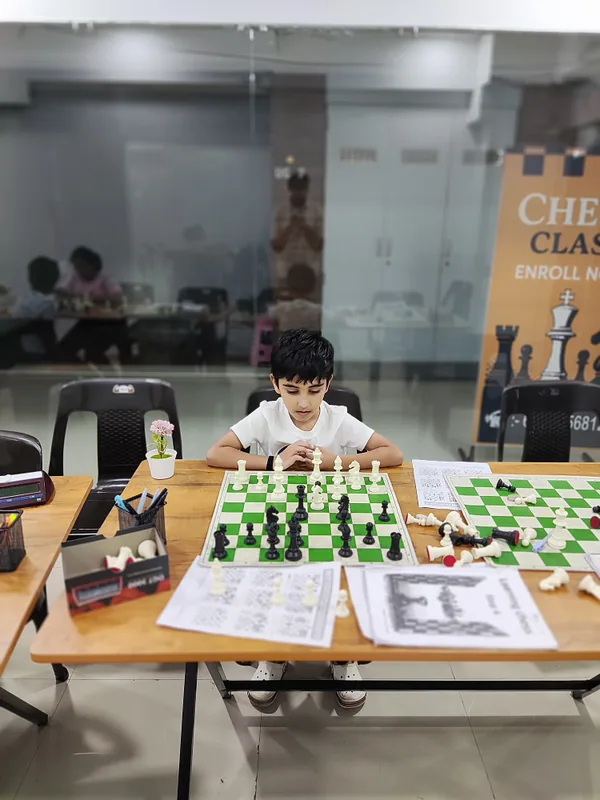
Chess notation is how every game, puzzle book and tournament scoresheet records moves. It looks like code — 1.e4 e5 2.Nf3 Nc6 — but it takes about ten minutes to learn. This guide teaches standard algebraic notation step by step, with the symbols you will meet in books and the rules for writing moves in a tournament. At Surat Chess Club every student learns it in the first term.
Step 1 — every square has a name
Look at the board from White's side. The eight columns, called files, are lettered a to h from left to right. The eight rows, called ranks, are numbered 1 to 8 from White's side to Black's.
A square's name is its file then its rank: e4 is the square where the e-file meets the fourth rank. There are 64 names and each one belongs to exactly one square, no matter which side of the board you sit on.
Two checks that catch most beginners' mistakes: the bottom-right square from White's side is always a light square (h1), and the white queen starts on d1 — her own colour.
Practice: find e4, d5, f7 and b1 on the diagram, then on a real board. Our free analysis board shows coordinates too.
Step 2 — one capital letter per piece
Each piece except the pawn has a capital letter. A move is written as the piece's letter plus the square it moves to.
Ke2 — the king moves to e2.
Qh5 — the queen moves to h5.
Rd1 — a rook moves to d1.
Bc4 — a bishop moves to c4.
Nf3 — a knight moves to f3. It is N, not K, because K is already the king.
e4 — a pawn moves to e4. A move with no capital letter is always a pawn move.
Step 3 — captures, checks and special moves
x — capture
Bxf7: the bishop captures on f7. For a pawn capture, write the file it came from: exd5 means the e-pawn captures on d5.
+ — check
Qh5+: the queen moves to h5 and gives check.
# — checkmate
Qxf7#: the queen captures on f7 and it is checkmate. Some books write ++ instead.
O-O and O-O-O — castling
O-O is castling on the king's side (short). O-O-O is castling on the queen's side (long). Written with capital letter O, not zero.
=Q — promotion
e8=Q: a pawn reaches e8 and becomes a queen. Promoting to a knight is e8=N.
e.p. — en passant
exd6 e.p.: a pawn captures en passant, landing on d6. The "e.p." is optional; the move is written like any pawn capture.
Step 4 — when two pieces could make the same move
If both of your knights could jump to d2, Nd2 is ambiguous. Add the file the moving piece starts on: Nbd2 means the knight from the b-file goes to d2; Nfd2 means the one from the f-file.
If both pieces are on the same file, use the rank instead: R1e2 means the rook on the first rank moves to e2. In the rare case that neither is enough — three queens after promotions — give the full starting square, like Qh4e1.
This is the one rule beginners forget on scoresheets. Arbiters and coaches can usually work out what was meant, but get into the habit early.
Step 5 — reading a whole game
Moves are numbered in pairs: White's move, then Black's. Here is the shortest trap every beginner should know — the four-move checkmate. Play it out on a board as you read.
e4 e5
White's e-pawn goes to e4; Black answers with the e-pawn to e5.
Bc4 Nc6
White's bishop comes to c4, aiming at f7. Black brings a knight to c6.
Qh5 Nf6??
White's queen joins the attack on f7. Black develops a knight but misses the threat — "??" marks a blunder.
Qxf7#
The queen takes on f7, protected by the bishop. Checkmate. Black should have played 3...g6 or 3...Qe7.
When a line starts with Black's move, it is written with three dots: 3...Nf6. A result is written at the end: 1-0 (White won), 0-1 (Black won) or ½-½ (draw).
The punctuation in chess books
Books and coaches add symbols after a move to say what they think of it. You will never write these on a tournament scoresheet, but you will see them everywhere else.
A strong, often hard-to-find move.
An outstanding move, often a surprising sacrifice.
A poor move that makes things worse.
A serious error, usually losing material or the game.
A risky or creative move worth considering.
Probably not best, though not clearly a mistake.
Writing moves in a tournament
In classical (standard) tournaments, FIDE's Laws of Chess require both players to record every move — theirs and their opponent's — on a scoresheet, in algebraic notation. A few rules matter from the first game:
- Move first, then write. Writing a move before playing it is not allowed.
- Keep it legible. The scoresheet is the official record if there is a dispute, and it is how arbiters check three-fold repetition and the fifty-move rule.
- Short of time? A player with less than five minutes left may stop recording, unless the game has an increment of 30 seconds or more per move.
- Rapid and blitz events usually do not require notation at all — though writing moves in rapid games is excellent practice.
Scoresheets are also the best coaching material there is. Our students bring theirs to class after every tournament, and the review starts from the moves they wrote down. It is why we teach notation — and tournament habits — from the first term, on every plan.
Chess notation — common questions
What does Nf3 mean in chess?
Why is the knight N and not K?
How do you write castling in chess notation?
What does x mean in chess notation?
What is the difference between + and # in chess notation?
Do kids need to write moves in chess tournaments?
What is descriptive notation?
Keep reading
Learn the game properly
Notation, clocks and tournament habits from the first term — in small offline batches in Vesu, Surat. The first class is free.