Rapid, Blitz and Classical Chess: Time Controls Explained
What does "15+5" mean on a tournament poster? Is a 10-minute game rapid or blitz? Does a rapid tournament count for a FIDE rating? This guide explains chess time controls, increments and chess clocks in plain language — for parents entering a child in a first event and for adults coming back to the game. Written by the coaches at Surat Chess Club, who have run rapid tournaments in Surat.
The three formats, in one minute
FIDE, the international chess federation, sorts games by how much time each player has. For a game with an increment, count the base time plus the increment multiplied by 60 — the length of a typical 60-move game.
Each player has ten minutes or less for the whole game. Fast, tense and great fun — but decisions are made on instinct. Common: 3+2, 5+0.
The usual format for junior and one-day open tournaments. Enough time to think, short enough for five or six rounds in a day. Common: 10+5, 15+5, 15+10, 25+10.
Long games over one or two rounds a day, with moves recorded on a scoresheet. A typical FIDE time control is 90 minutes for 40 moves, then 30 more minutes, with 30 seconds added per move.
How to read "15+5" and other time controls
The first number is the base time in minutes each player starts with. The second is the increment in seconds added to a player's clock after every move they make, from move one.
So 15+5 — the time control of our Junior Rapid Chess Championship 2026 — means each player starts with 15 minutes and gains 5 seconds every time they complete a move. A game of 40 moves each lasts about 35 minutes at most.
10+5 — used at our July 2026 tournament and the Chess Coffee Connect showdown — is also rapid, not blitz: 10 minutes plus 60 × 5 seconds counts as 15 minutes.
5+0 or 5|0 means five minutes with no increment — blitz, and a player who runs out of time loses however good their position.
Written notation varies: "15+5", "15|5", "15 min + 5 sec" and "G15 inc 5" all mean the same thing.
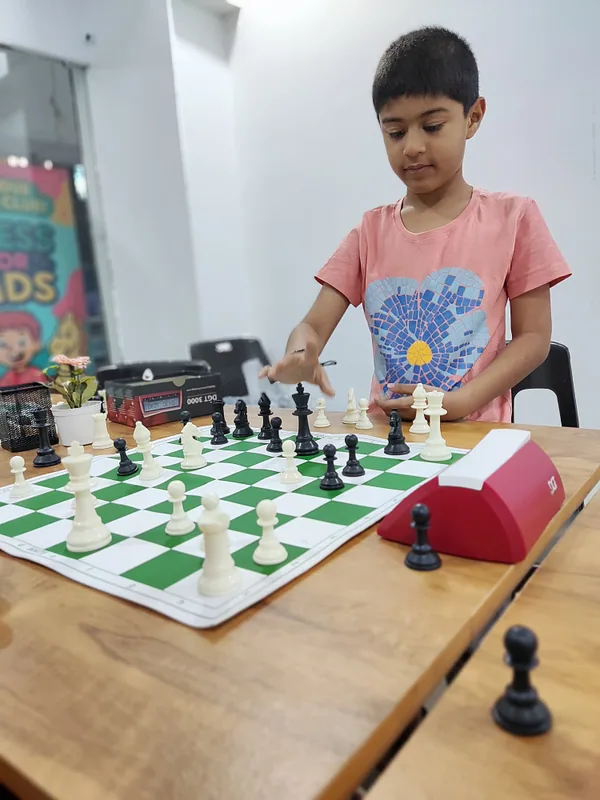
Increment, delay and sudden death
Increment (Fischer)
A fixed number of seconds is added after every move. Used in almost every FIDE event. It means a player is never left with literally zero seconds to make a simple move — which makes rapid chess far kinder to children.
Delay
The clock waits a few seconds before it starts counting down each move, but unused delay is not banked. Common in the United States, rare in India.
Sudden death
No increment and no delay — "5+0". When the time is gone, the game is lost, unless the opponent cannot possibly checkmate. Exciting, and hard on young players.
Chess clock rules every beginner should know
Same hand
Press the clock with the same hand you moved the piece with. Moving with one hand and pressing with the other is not allowed.
Move, then press
Your move is not complete until you press the clock. Forgetting to press is the most common way children lose time — and the opponent is not obliged to remind you.
Flag fall
If your time reaches zero, you lose — unless your opponent has no possible way to checkmate you, for example a lone king. Then the game is a draw.
Stop and raise a hand
For any problem — an illegal move, a dispute, a faulty clock — pause the clock and call the arbiter. Only the arbiter rules.
Time controls and FIDE ratings
FIDE keeps three separate rating lists — standard, rapid and blitz. A player can have a rapid rating and no standard rating, or three quite different numbers. Only events that are registered with FIDE count towards any of them; most club and junior events, including every event we hosted in 2026, are unrated.
When people say "FIDE rating" without a qualifier, they usually mean the standard rating from classical games. Our FIDE rating guide for Surat players explains how to get one, step by step.
Which format is best for a child?
Rapid with an increment — 10+5 or 15+5. Enough time to think, and the increment removes the panic of a clock at zero. See our first-tournament guide for parents.
Longer rapid games (15+10, 25+10) and then classical. Slow games are where calculation and patience improve; blitz mostly rehearses what a player already knows.
Blitz, in moderation. It is enjoyable and sharpens pattern recognition, but a diet of only blitz tends to build fast, careless habits.
Chess time controls — common questions
What does 15+10 mean in chess?
Is 10 minutes chess rapid or blitz?
How long does a rapid chess game last?
What happens if you run out of time in chess?
Do you have to write down moves in rapid chess?
Are rapid tournaments FIDE rated?
Keep reading
Play with a clock — properly
Our students use chess clocks from their first term, so the first tournament feels like class. Hear about the next rapid event in Surat, or book a free trial.